
It’s crucial for you to stay informed about the transformative power of next-gen AI technologies that are revolutionizing various industries today. From healthcare to finance, AI applications are enhancing efficiency, driving innovation, and improving decision-making. This blog post will guide you through the most impactful AI implementations that are not only influencing operational capabilities but also creating new opportunities while posing significant challenges you should be aware of.
Healthcare Innovations
Diagnostics and Predictive Analytics
Next-gen AI is revolutionizing diagnostics by enabling earlier detection of diseases through advanced imaging and data analysis. For instance, AI algorithms can analyze medical imaging with accuracy rates nearing 97%, significantly outpacing human counterparts. Moreover, these technologies gather patient data to predict potential health risks, allowing healthcare providers to implement preventive measures that can save lives and lower costs.
Personalized Medicine
Personalized medicine tailors treatment plans to individual patients by analyzing genetic, environmental, and lifestyle factors. By utilizing your unique genetic makeup, AI can help identify the most effective therapies, potentially increasing efficacy rates by up to 50%. This approach is particularly effective for chronic diseases like cancer, where treatments can be customized based on specific mutations found in tumor cells.
For example, a study demonstrated that patients with specific genetic markers responded better to targeted therapies, significantly improving their outcomes. With continuous advancements, you will find AI algorithms that can process genomic data rapidly, allowing for real-time adjustments in treatment plans. The integration of AI in personalized medicine not only enhances therapeutic effectiveness but also minimizes adverse effects, ensuring that your treatment journey is as safe and efficient as possible.
Financial Services Transformation
Next-generation AI is driving significant changes in financial services, enhancing efficiency and accuracy across the sector. By automating processes and providing deep analytical insights, AI technologies streamline operations, improve customer experiences, and reduce costs. This transformation enables institutions to respond faster to market dynamics, tailor services to individual needs, and maintain compliance while navigating complex regulations.
Fraud Detection and Risk Management
AI-driven solutions in fraud detection and risk management are revolutionizing how financial institutions protect against threats. With the ability to analyze vast datasets in real-time, these systems identify anomalies and suspicious activities more effectively than traditional methods. This proactive approach not only reduces losses but also strengthens customer trust, as institutions can respond swiftly to potential fraud instances.
Algorithmic Trading
Algorithmic trading leverages AI to execute trades at optimal prices and speeds, tapping into real-time market data. Advanced algorithms can analyze complex datasets and discern patterns, enabling you to capitalize on opportunities faster than human traders. This integration of technology has led to increased market efficiency and reduced transaction costs.
In algorithmic trading, AI systems utilize machine learning and historical data to create predictive models. These models analyze various market indicators and conditions to execute trades automatically when specific criteria are met. A study by TABB Group found that over 80% of stock trades are now executed by algorithms. These systems can process data at lightning speed, react to market movements almost instantaneously, and minimize human error, making them invaluable for institutional investors and hedge funds aiming for competitive advantages.
Retail Enhancement
Customer Experience and Personalization
Next-gen AI significantly enhances customer experience by offering personalized product recommendations and tailored marketing strategies. For instance, AI algorithms analyze your browsing and purchasing history, allowing retailers to engage you with relevant content and promotions, increasing not only customer satisfaction but also loyalty. Companies like Amazon and Netflix are prime examples of this approach, utilizing AI to foster deeper connections with their customers.
Inventory Management and Supply Chain Optimization
Advanced AI technologies streamline inventory management and optimize supply chains, ultimately reducing costs and improving service levels. By leveraging predictive analytics, these systems can forecast demand trends, assist in replenishment strategies, and minimize stockouts. Retailers using AI in their supply chains see improvements in efficiency, cutting inventory costs by up to 25% while also enhancing order fulfillment rates.
When focusing on inventory management and supply chain optimization, AI tools can analyze vast datasets in real-time, enabling you to adjust stock levels according to fluctuating demand patterns. For instance, retailers implementing AI-driven solutions can anticipate seasonal shifts, adjusting their inventory to align with customer behavior. Companies like Walmart utilize AI for improved forecasting, leading to enhanced product availability and reduced excess stock. AI implementations in logistics further refine operations by optimizing routes, reducing transportation costs, and thereby allowing you to deliver products quicker and more efficiently.
Manufacturing Advancements
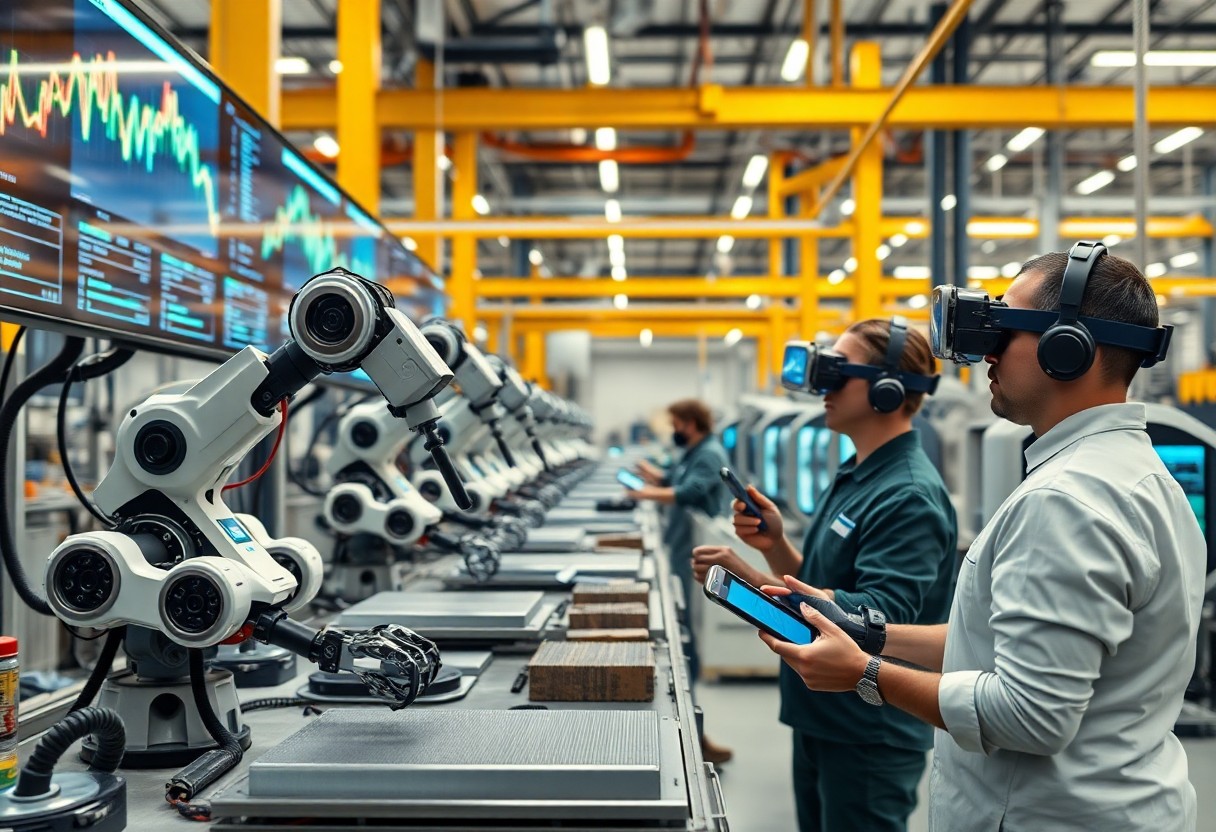
Advanced AI applications are revolutionizing the manufacturing sector, minimizing downtime, enhancing efficiency, and ensuring product quality. With the ability to process vast amounts of data in real time, next-gen AI equips manufacturers with tools to streamline operations, predict equipment failures, and automate inspection processes, ultimately transforming traditional factory environments into smart, responsive ecosystems.
Predictive Maintenance
Predictive maintenance leverages AI to analyze data from machinery sensors, allowing you to anticipate equipment failures before they occur. By monitoring vibrations, temperatures, and other critical metrics, AI systems can provide actionable insights, significantly reducing downtime and maintenance costs. Industries that implement predictive maintenance report up to a 30% decrease in maintenance expenditures.
Quality Control Automation
Quality control automation utilizes AI-driven technologies to ensure products meet strict standards with minimal human intervention. By implementing machine vision systems, you can achieve a faster and more accurate inspection process. These AI systems can inspect thousands of units per hour, identifying defects with an accuracy rate often exceeding 95%, which drastically reduces the risk of faulty products reaching customers.
AI-powered quality control provides your manufacturing facility with a competitive edge by reducing error rates and improving production throughput. For example, a leading automotive manufacturer adopted deep learning algorithms for assembly line inspections, resulting in a 50% reduction in defects. You gain the ability to catch discrepancies in real time, ensuring only the best products reach the market, which not only enhances your brand reputation but also boosts customer satisfaction and loyalty.
Education Revolution
The education sector is undergoing a profound transformation thanks to next-gen AI, shaping how you learn and interact within educational environments. By integrating AI-driven tools, educational institutions can provide tailored content that meets diverse learning needs, enhancing student engagement and achieving better outcomes.
Personalized Learning Experiences
You benefit from AI’s ability to create personalized learning experiences, adapting resources and methodologies to suit your unique learning style. For example, platforms like Knewton and DreamBox use algorithms to assess your understanding and modify lessons accordingly, resulting in a more effective learning process.
Administrative Efficiency
AI significantly boosts administrative efficiency, streamlining tasks such as scheduling, grading, and resource allocation. By automating repetitive processes, schools can reallocate human resources to more critical areas, improving the overall educational experience.
For instance, AI tools like ChatGPT and IBM Watson assist with instant communication, enabling you to receive feedback and answers quickly, which enhances your learning experience. Furthermore, institutions like Georgia State University have leveraged chatbots to handle over 300,000 student inquiries, freeing up staff to focus on more complex issues and improving student satisfaction. This efficiency not only reduces administrative burdens but also enhances the overall resource allocation, allowing for a more responsive educational environment tailored to your needs.
Transportation and Logistics
Next-gen AI is revolutionizing transportation and logistics, streamlining operations, enhancing safety, and reducing costs. With advanced analytics and real-time data processing, businesses can now optimize their supply chains, improve delivery times, and create smarter transportation networks. Companies like Amazon and UPS are leveraging these technologies, leading to improved efficiency and a remarkable competitive edge in the market.
Autonomous Vehicles
Autonomous vehicles are reshaping the landscape of transportation, allowing for safer, more efficient travel. By utilizing AI algorithms, these vehicles can analyze their environment and make real-time decisions, reducing the likelihood of human error. Companies like Waymo are already piloting fully autonomous rides, paving the way for broader adoption. You can expect decreased transportation costs and enhanced delivery services as this technology matures.
Route Optimization
Route optimization employs AI to calculate the most efficient paths for vehicles, leading to time savings and reduced fuel consumption. Algorithms analyze traffic patterns, weather conditions, and other variables, allowing for dynamic rerouting. Businesses that utilize AI-driven route optimization can expect up to a 20% reduction in delivery times and a significant drop in operational costs. These developments not only benefit logistics companies but also enhance customer satisfaction through timely deliveries.
In essence, route optimization is about leveraging data to maintain high service levels while minimizing expenses. Technologies such as machine learning and predictive analytics allow you to assess historical traffic data and forecast potential disruptions. For instance, companies like FedEx have implemented AI-driven systems to adjust delivery routes on-the-fly, effectively responding to real-time conditions. By prioritizing efficiency, you’re not only streamlining operations but also contributing to a more sustainable logistics model, ultimately positioning your business for growth in a competitive marketplace.
Conclusion
Upon reflecting, you can see that next-gen AI applications are significantly transforming various industries by enhancing efficiency, personalization, and decision-making. From healthcare advancements to optimized supply chains and smarter customer interactions, these technologies are not just trends; they are reshaping the operational landscape. By staying informed and adaptable, you can better harness these innovations to improve your business strategies and outcomes in today’s evolving market.
FAQ
Q: What are the key applications of Next Gen AI in healthcare?
A: Next Gen AI is transforming healthcare through predictive analytics for patient outcomes, personalized medicine tailored to individual genetic profiles, and AI-powered diagnostics that enhance early detection of diseases. Additionally, AI streamlines administrative tasks, allowing healthcare professionals to focus more on patient care.
Q: How is Next Gen AI impacting the financial sector?
A: In the financial sector, Next Gen AI is utilized for fraud detection by analyzing transaction patterns in real-time, algorithmic trading that enhances investment strategies, and personalized financial advice through robo-advisors. These applications increase efficiency, minimize risk, and improve customer satisfaction.
Q: In what ways is Next Gen AI reshaping the retail industry?
A: Retailers are leveraging Next Gen AI for inventory management through predictive analytics that optimize stock levels, personalized shopping experiences through recommendation systems, and enhanced customer service via chatbots and virtual assistants. This leads to improved operational efficiency and higher customer engagement.